Most photos of front yard landscaping ideas feature yards that were already beautiful: a stone cottage, a professional crew, a June morning. This guide starts with a more ordinary front yard, like the one below. A beige ranch house, a garage, a lawn going yellow in patches, a row of junipers that has quietly grown up to the windowsills, and a concrete walk that stops in the middle of the grass.
So instead of collecting photos of thirty different yards, this guide takes that one ordinary front yard and redesigns it four ways, then breaks the results into individual ideas you can copy, sorted by the situation you're in: small yards, low maintenance, dry climates and tight budgets.
Quick answer: the front yard landscaping ideas that change curb appeal most are a clear path from the street to the front door, foundation plants that stay below the windowsills, crisp bed edges against the lawn, a small tree or tall shrub to frame each corner of the house, and low lighting along the walk. For small or low-maintenance yards, shrink the lawn and repeat a few tough plants. In dry climates, swap lawn for gravel and drought-tolerant plants.
The starting point: one ordinary front yard
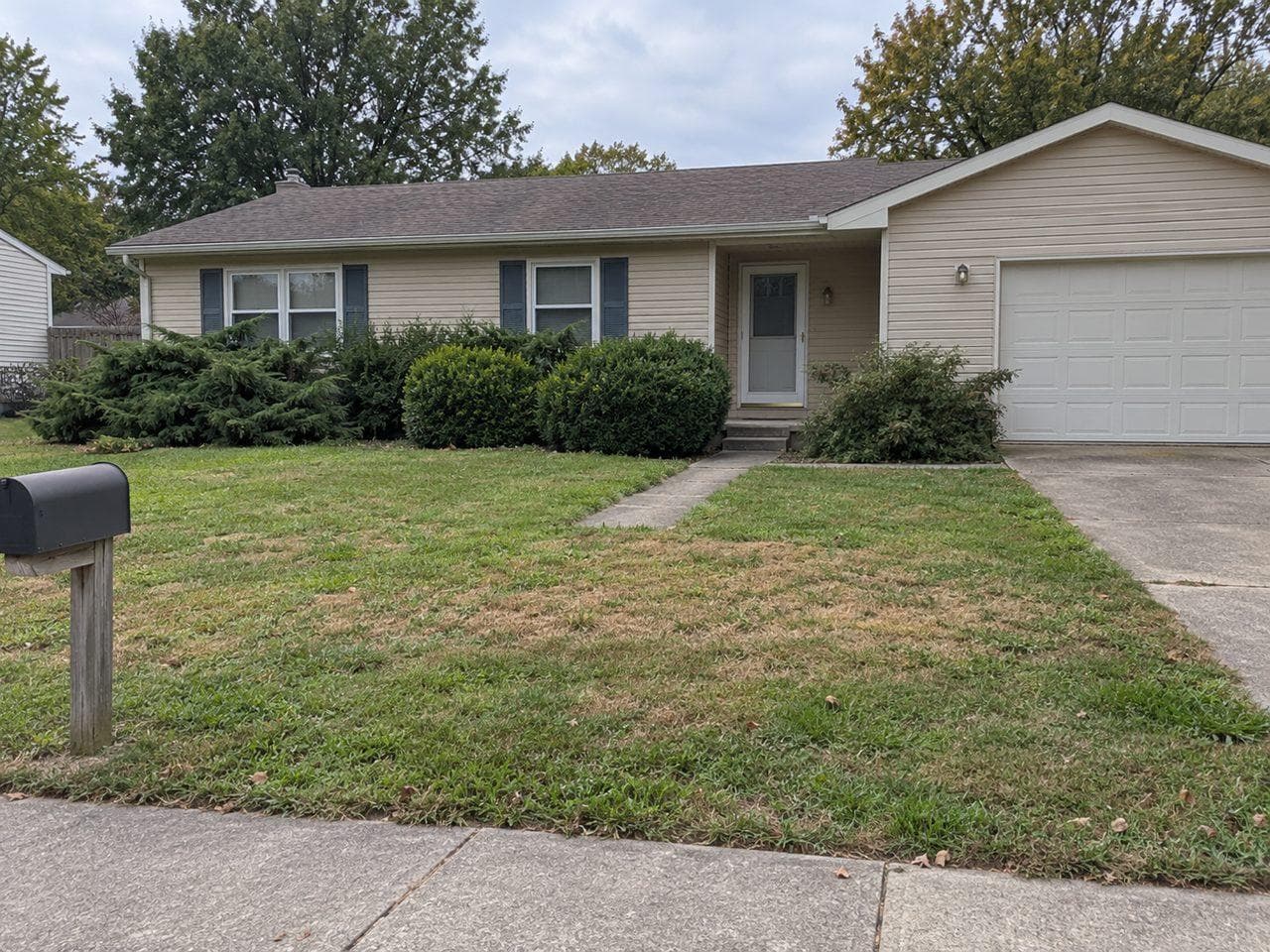
Before looking at fixes, it helps to name what's actually wrong here, because the same four problems show up in most American front yards built in the last fifty years:
- The walk goes nowhere. It runs a few slabs out from the front step and ends in the lawn, so visitors walk up the driveway instead. The front door is hard to find from the street.
- The foundation shrubs have outgrown their job. The junipers and boxwoods were probably knee-high once; now they reach the bottom of the windows and hide half the facade.
- There's no edge anywhere. Lawn runs straight into shrubs and straight into the driveway, so nothing looks deliberate.
- The lawn is doing all the work, and it's tired. Patchy, yellowing grass is the largest surface in the photo.
We ran this photo through Roomvana in four of its 23 styles: Modern, Cottagecore, Mediterranean and Modern Farmhouse. The house, garage, shutters and mailbox stay put in every version, which is what makes the comparison useful: only the landscaping changes.
1. Modern: big pavers, dark beds and path lights
Before After
The modern version fixes the biggest problem first: the walk now runs all the way from the sidewalk to the front step, built from oversized concrete slabs with dark beds on either side. The overgrown junipers are gone, replaced by white hydrangeas that sit lower than the windows. Lavender and ornamental grasses fill the beds in drifts, a red Japanese maple marks the corner by the garage, and a row of low path lights shows the way at night. Half the lawn survives, cut into one clean shape on the left.
Copy this if your house has simple lines (ranch, split-level, mid-century) and you want the yard to look sharper rather than softer. The slab walk is a realistic weekend-to-week project with precast pavers; the maple wants afternoon shade in hot climates.
2. Cottage garden: stepping stones and mixed borders
Before After
The cottage version trades most of the lawn for loose, mixed borders of coneflowers, daisies and other perennials, with a stepping-stone path set into the grass and a hanging basket and potted flowers by the door. It's the friendliest-looking of the four, and the one that needs the most attention: cottage borders are lovely in July and need cutting back, dividing and weeding to stay that way.
If you love this look, keep the tall perennials toward the middle of the yard and the short ones under the windows, so the planting never climbs over the sills, the same trap the original junipers fell into. A low picket fence by the driveway, like the one in this version, is an easy way to frame the beds.
3. Mediterranean: a low-water front yard
Before After
The Mediterranean version removes the lawn completely. A wide natural-stone walk runs from the sidewalk to the step, flanked by lavender, silver-leaved shrubs and a river-rock bed with a small terracotta urn fountain. An olive tree stands in front of the left window and a narrow cypress marks the house corner, with terracotta pots beside the door.
This is the closest thing in the set to a xeriscape: gravel and mulch where the grass was, plants that like heat and dry soil, and almost nothing to mow. Two cautions before you copy it plant for plant. Olive trees generally survive outdoors only in mild-winter areas (roughly USDA zone 8 and warmer), so in a cold climate you'd swap in a hardy small tree with silvery foliage. And lavender rots in heavy, wet clay, so it needs sharp drainage or a raised, gritty bed.
4. Modern farmhouse: keep the lawn, fix the beds
Before After
The farmhouse version is the most conservative, and for many homeowners the most realistic. The lawn stays, but it's healthy and cut into a clean shape with curved, mulched bed edges. White hydrangeas and purple salvia line the foundation below the windows, two narrow conical evergreens add height against the wall, and a new curved bed wraps the mailbox post.
If you like this look, run the walk all the way to the sidewalk or the driveway so guests have a clear path to the door.
Front yard landscaping ideas for curb appeal
Curb appeal comes down to a short list of moves, and all four redesigns above use most of them. These are the ideas to start with on almost any front yard, whatever the style.
5. Make the walk reach the street
A front walk should connect the front door to wherever people actually arrive: the sidewalk, the driveway, or both. Aim for at least 4 feet wide; 5 feet lets two people walk side by side. A walk that dead-ends in the lawn, like the original one above, sends guests up the driveway and makes the entry feel like a side door.
6. Keep foundation plants below the windowsills
Foundation shrubs should frame the house, not cover it. Check the mature height on the plant tag and pick shrubs that top out below the bottom of your windows. Most overgrown front yards, including the one in this guide, are just foundation plants that were never chosen for their mature size.
7. Frame the corners of the house
A small tree or tall, narrow shrub near each corner makes a house look settled into its lot. The modern version uses a Japanese maple by the garage; the Mediterranean one uses a cypress. Plant trees far enough from the foundation that the mature canopy clears the roof.
8. Cut a clean edge between lawn and beds
A crisp edge, whether steel, brick or just a sharp spade cut refreshed each spring, is the cheapest way to make a yard look maintained. Gentle curves or straight lines both work. Avoid wiggly edges that look like they were drawn by the mower.
9. Light the walk and the door
Low path lights along the walk and a working fixture by the door make the house look cared for after dark and keep the steps safe. Three or four well-spaced lights beat a runway of cheap ones.
10. Plant around the mailbox
Every one of the four redesigns put a small bed around the mailbox post, and it's worth copying. The mailbox sits right at the street, so a ring of low perennials there is often the first thing a visitor sees.
11. Group pots by the front door
Two or three containers in one color family by the step, or a hanging basket like the cottage version, draw the eye to the entry. Pots are also the easiest place to grow something that isn't hardy in your zone.
Small front yard landscaping ideas
A small front yard looks bigger when it has fewer, larger moves: one path, one tree, one or two plant types repeated. Clutter, not size, is what makes a small yard feel cramped.
12. Shrink the lawn or remove it
On a small lot, a strip of lawn is often more work than it's worth: too small to use, still needs a mower. Widening the beds, as in the modern version, or replacing grass entirely, as in the Mediterranean one, usually makes a small front yard look more generous.
13. Use one small tree, not three
Pick a tree that stays small at maturity, such as a Japanese maple, a serviceberry or a dwarf redbud, and give it room. Several young trees on a small lot will crowd each other and the house within a decade.
14. Repeat a few plants
Choose two or three plants and repeat them in groups of three or five. Repetition reads as design; one of everything reads as a nursery sale. The modern version is a good model: lavender and grasses, repeated down both sides of the walk.
15. Keep the street side low
In a shallow yard, put the tallest plants against the house and step down to the shortest at the sidewalk. The house stays visible from the street and the yard gains depth.
Low-maintenance and grass-free front yard ideas
16. Swap lawn for ground cover
Creeping thyme, clover, sedges and other low ground covers fill the same space as grass without weekly mowing. Most handle light foot traffic, not football games, so keep a path for the places people walk.
17. Mulch or gravel the beds properly
A 2- to 3-inch layer of mulch keeps weeds down and soil moist, and gravel does the same in dry climates. The dark beds in the modern version are a good example: plants grouped in drifts, bare ground covered, trimming needed only twice a year.
18. Choose natives and tough perennials
Plants native to your region are adapted to its rain and winters, so they need less watering and fussing once established. Your state's cooperative extension service publishes native plant lists, and the USDA Plant Hardiness Zone Map tells you which plants will survive your winters.
Front yard ideas for dry climates
In the Southwest, California and other dry regions, the best front yard idea is usually less lawn. The EPA's WaterSense program notes that a large share of household water goes to outdoor use, much of it on lawns. The Mediterranean redesign above shows the basic recipe.
19. Replace turf with gravel or stone
Gravel, river rock or decomposed granite over landscape fabric takes the place of lawn, and a natural-stone walk suits it better than poured concrete. Keep at least one small tree near the house: its shade cools the facade and stops a gravel yard from looking like a parking lot.
20. Group drought-tolerant plants on drip irrigation
Plant drought-tolerant shrubs and grasses in groups and water them with drip lines rather than sprinklers. Agave, salvia, lavender, rosemary, manzanita and native grasses are common choices in dry regions, but check each one against your own zone and soil before buying.
How to choose the right idea for your house
The right front yard landscaping idea is the one that suits your house, your climate and how much time you'll actually spend outside. A few practical checks narrow it down fast:
- Judge it from the street. Take a photo from the far sidewalk, where neighbors and buyers see your house. Ideas that look good from the porch can disappear from the curb.
- Match the house, not the photo. A low, wide ranch suits low, wide planting and a strong horizontal walk. A tall two-story house can take bigger trees and taller shrubs.
- Check your zone and your water. Find your USDA hardiness zone and be honest about watering. A lush lawn in Phoenix or a lavender bed in wet clay will fight you every year.
- Check the rules. HOAs often regulate lawn replacement, fences and front-yard plants, and some cities restrict what can go in the strip by the curb.
- Call before you dig. Front yards often hide gas, water and cable lines. Calling 811 a few business days ahead gets them marked for free.
- Decide your maintenance budget in hours. Cottage borders need weekly attention in summer; gravel and grasses need a cleanup twice a year.
If you want the design rules behind these choices, such as the 3-5-7 rule for odd-numbered plant groupings and the seven principles of landscape design, our step-by-step guide to designing your own yard covers them in detail.
On a tight budget, start with the cheap, high-impact moves: edge the beds, mulch, remove the shrubs that cover the windows, and add lighting. Our list of backyard ideas on a budget has more low-cost projects that work just as well out front.
Try these ideas on a photo of your own front yard
Every redesign in this guide came from one photo. You can do the same with your own house in Roomvana's AI landscape design tool: stand on the sidewalk, take one photo that shows the whole front of the house, the walk and the lawn, upload it and try a few styles. Your house, driveway and camera angle stay the same, so you're comparing landscaping, not different houses.
Before you buy anything, swap the plants in your favorite version for ones that grow where you live; a local nursery can match the look with plants suited to your area.
See your front yard redesigned
Take one photo from the street, upload it and compare styles on your own house. Free to try after Google sign-in.
Redesign my front yard